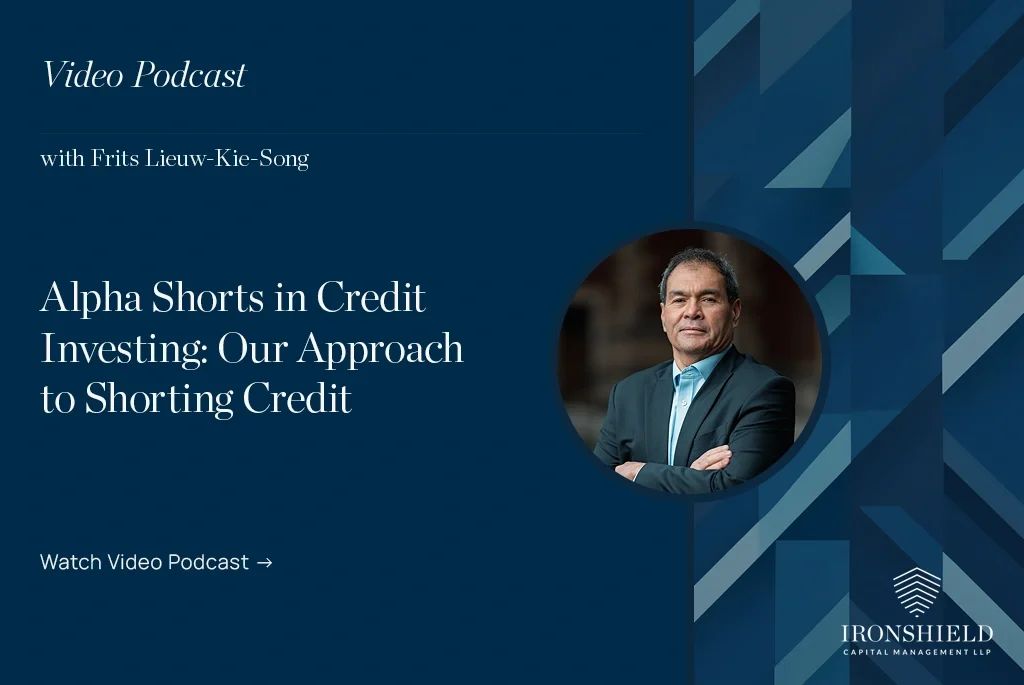
At Ironshield, our approach to shorting credit is deliberately selective. A negative view on a company is not enough on its own. For an alpha short to make sense, we want to see both a fundamental reason to be negative and a catalyst capable of forcing the market to reassess the credit. These are alpha-generating positions based on specific credit views, rather than shorts held simply as a portfolio hedge.
Our Portfolio Manager Frits Lieuw-Kie-Song discussed this approach in a recent episode of Fixed + Floating, where he explored what makes a short worth owning, why timing matters, and why a weak earnings outlook alone is often not enough.
A weak outlook is not always enough
A company may look vulnerable because earnings are expected to disappoint, leverage is high or growth is slowing. But for us, that does not automatically make it a short.
Frits’ point is that a modest earnings miss — for example, earnings coming in 5–10% below expectations — may not be sufficient to change the market’s view. If investors continue to believe the broader growth story, the credit may remain resilient despite weaker numbers.
The more important question is therefore:
What could actually break the story the market currently believes?
That might be a permanent increase in competition, a refinancing event, deteriorating liquidity or another identifiable pressure point that changes the outlook for the business in a more lasting way.
The role of the catalyst
For us, the catalyst is what connects the fundamental view to repricing.
Without one, a short can become an expensive waiting game. Frits described shorting without a catalyst as potentially both painful and costly, particularly given the carry and borrow involved.
Timing therefore matters. A credit can ultimately deteriorate significantly, but if the catalyst takes longer than expected to emerge, the economics of holding the short can become less attractive. Frits also noted that even when a bond eventually falls substantially, very few investors remain short for the entire move.
Fundamental work still comes first
A catalyst on its own is not enough either.
The underlying credit work still has to support the thesis. That means understanding why the company’s earnings or growth assumptions may be vulnerable, how durable those weaknesses are, and what could change investor perception.
Frits’ experience with WorldCom is instructive. The company appeared to have unusually strong economics, with EBITDA margins materially higher than peers such as AT&T. It ultimately proved to be fraud. One of the lessons he took from that experience was the importance of understanding why a company is capable of producing superior economics and independently verifying that explanation.
That same discipline applies on the short side: identify what is structurally wrong, understand why it matters, and then ask what could make the market recognise it.
Our philosophy
Each short needs to stand on its own as an investment thesis. We are looking for situations where the downside case is supported by the fundamentals and where there is a credible path to repricing.
That framework helps us distinguish between companies that simply look weak and situations where we believe the market has a reason to change its view.
It is a deliberately selective approach — but in our view, that selectivity is essential when the cost of being early can be just as important as the risk of being wrong.